
Why Vietnam’s Best Restaurants Are Moving Toward Artisanal Wine


There was a time when a serious wine list in Vietnam meant the same thing almost everywhere.
Big Bordeaux. Heavy bottles. Famous names. Safe choices.
The wine often arrived at the table carrying more status than emotion.
But Vietnam’s restaurant scene has changed.
Fast.
Walk into the country’s most exciting dining rooms today and you feel it immediately. The atmosphere is looser. The food is more personal. Chefs are cooking with sharper identities. Open kitchens roar behind small dining rooms. Music matters. Lighting matters. Service matters. Guests ask questions now.
And quietly, almost naturally, the wines changed too.
Not toward bigger labels.
Toward more alive bottles.
Toward artisanal wine.
A different kind of luxury
Luxury used to be easy to recognize.
Heavy glass. Gold lettering. Powerful reds. Prestige appellations.
Today, many of Vietnam’s best sommeliers and chefs are searching for something else entirely.
Precision. Freshness. Energy. Emotion.
A small grower farming by hand in the Jura. A young Bordeaux producer harvesting earlier for freshness. A skin contact wine with texture and tension. A bottle that tastes like a place instead of a recipe.
That has become the new language of modern wine service.
Not because guests suddenly became wine experts.
Because restaurants themselves changed.
Vietnam’s fine dining scene no longer wants wine that dominates the table. It wants wine that participates in the meal.
Vietnam’s food naturally pushes wine in this direction

This shift makes even more sense when you look at the food.
Vietnamese cuisine lives on freshness.
Fresh herbs. Acidity. Charcoal. Fermentation. Citrus. Fish sauce. Bitterness. Crunch. Spice.
A bowl of bún chả cá exploding with dill and green onion. Grilled squid with lime and chili salt. Clams steamed with lemongrass. Smoky pork over broken rice. A spoonful of nước chấm sharp enough to wake up the palate instantly.
These flavors do not always want thick, oaky, powerful wines.
They often want brightness.
That is where artisanal wine suddenly feels obvious.
A tense Riesling. A saline Melon de Bourgogne. A lightly chilled Gamay. An energetic orange wine. A pale Jura Chardonnay.
These wines refresh instead of exhausting.
They create movement at the table.
And in a humid tropical climate like Vietnam, that matters more than many traditional European wine rules admit.
The sommelier’s role changed too
Ten years ago, many wine programs in Vietnam were still built around recognition.
Today, the best sommeliers are building identity.
That changes everything.
A great wine list is no longer just a catalogue of famous appellations. It is a reflection of the restaurant itself.
Artisanal wines help create that identity because they carry stories naturally.
Not marketing stories. Real ones.
A family farming five hectares. A winemaker working without herbicides. A difficult frost vintage. A wine bottled without filtration. A vineyard planted on limestone overlooking the Atlantic.
These details matter because modern guests want connection.
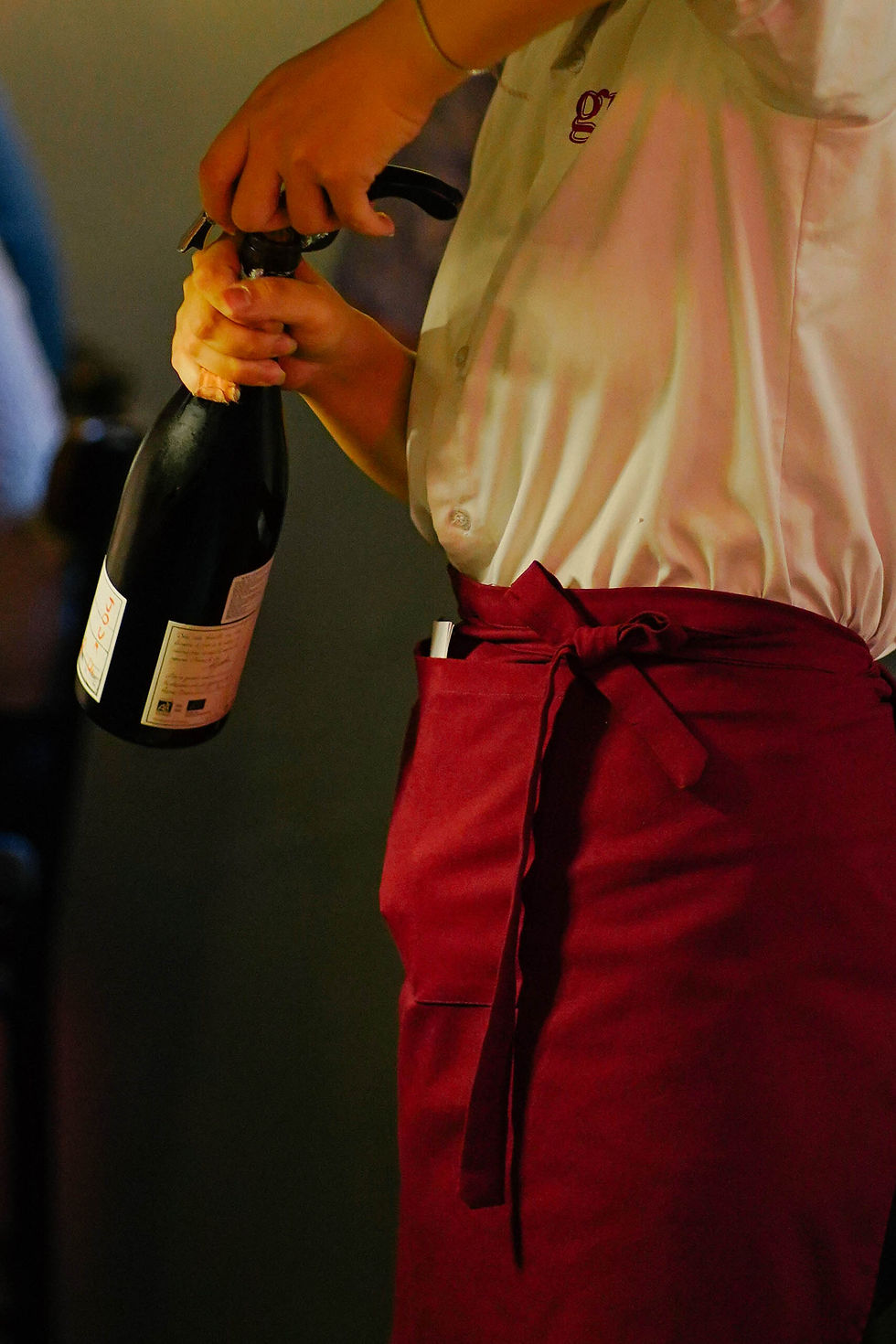
Tableside wine service has become more conversational in Vietnam’s best restaurants. Less intimidating. More human.
Instead of hearing:
“This is a Chardonnay from France.”
Guests now hear:
“This comes from a tiny grower working organically near Muscadet. The wine spends time on lees, giving texture, but keeps this incredible salty freshness that works beautifully with seafood.”
That changes the mood of the table immediately.
Wine stops feeling ceremonial. It becomes alive.
Natural wine opened the door, but precision keeps it there

Natural wine played a major role in this evolution.
It made wine feel less rigid. Less formal. Less trapped behind old hospitality codes.
Wine bars across Vietnam helped younger drinkers discover bottles that felt energetic, vibrant, and approachable. The movement encouraged curiosity.
But there is an important nuance here.
Not every artisanal wine deserves a place in fine dining.
This is where many people get confused.
Some wines hide flaws behind the word “natural.” Some bottles are unstable. Some feel more ideological than pleasurable.
Restaurants operating at a serious level still need precision.
The best artisanal wines succeed because they balance soul and control.
A producer like Marcel Lapierre can make wines full of life while remaining incredibly drinkable. Tony Bornard can make Jura wines that feel wild and deeply precise at the same time. Jérôme Bretaudeau can create whites with texture and tension that work beautifully with modern cuisine. The new generation of Bordeaux growers like Hugues Laborde are proving that freshness and drinkability can exist inside one of France’s most traditional regions.
That balance is what serious restaurants are searching for.
Not funk for the sake of funk.
Character with clarity.
Fine dining menus became lighter and more complex
Modern tasting menus changed the role of wine pairing entirely.
Today’s restaurants move through many textures and temperatures during a meal.
Raw seafood. Fermented sauces. Charcoal. Fresh herbs. Delicate broths. Spice. Smoked elements. Vegetable driven dishes.
Heavy wines struggle in these environments.
Artisanal wines often perform better because they are built differently.
Lower alcohol. Higher acidity. Less oak. More texture. More savory notes. More flexibility.
A chilled red can move from grilled fish to poultry. An oxidative Jura white can handle mushrooms, cream, and umami. A textured Chenin Blanc can carry an entire tasting menu without tiring the palate.
This versatility is one of the biggest reasons sommeliers increasingly prefer these wines.
Not because they are trendy.
Because they work.
Vietnam’s hospitality scene became more ambitious
The Michelin Guide accelerated this shift.
Not because every restaurant suddenly wanted stars.
But because the entire industry level rose.
Restaurants began paying more attention to sourcing, service, design, music, storytelling, and beverage programs.
Wine lists could no longer feel generic.
If a chef spends months refining dishes around local seafood, fermentation, smoke, and seasonality, the beverage side cannot simply rely on industrial luxury labels.
The wine program has to speak the same language as the kitchen.
That is exactly what artisanal wine allows.
A point of view.
Guests changed too
The guest sitting in Vietnam’s best restaurants today is different from ten years ago.
More travelled. More curious. More informed.
Many have eaten in Tokyo, Copenhagen, Paris, Hong Kong, Singapore, Bangkok, Seoul.
They are less impressed by obvious luxury.
They look for atmosphere now. Authenticity. Energy. Humanity.
A bottle with a real story often creates more emotion than a bottle chosen only for prestige.
And younger guests especially want discovery.
They want the sommelier to surprise them. They want wines they cannot easily buy everywhere. They want to feel part of something alive.
That is exactly where artisanal wine thrives.
The future of wine in Vietnam will belong to restaurants with identity

Vietnam is still a young wine market.
That is its strength.
There is still room to shape taste. Still room to build real wine culture. Still room for restaurants to define their own approach instead of repeating old luxury formulas.
The most exciting places in Vietnam today understand something important.
People do not remember restaurants only because the food was expensive.
They remember the atmosphere. The music. The lighting. The feeling of the room. The conversation. The bottle shared across the table.
Artisanal wine fits naturally into that world because it feels human.
Not perfect. Not manufactured. Not disconnected from where it came from.
Alive.
Maybe that is why these wines belong so naturally in Vietnam today.
Not because they are fashionable.
Because they feel alive.
And in the best restaurants, alive is exactly what people are looking for.


Comments